When we talk about eczema in livestock what we are really talking about is ‘photosensitivity’.
Photosensitivity is sunlight-induced swelling, reddening, scabbing and/or peeling of white or unpigmented areas of skin as a result of liver damage and/or ingestion of certain crops.
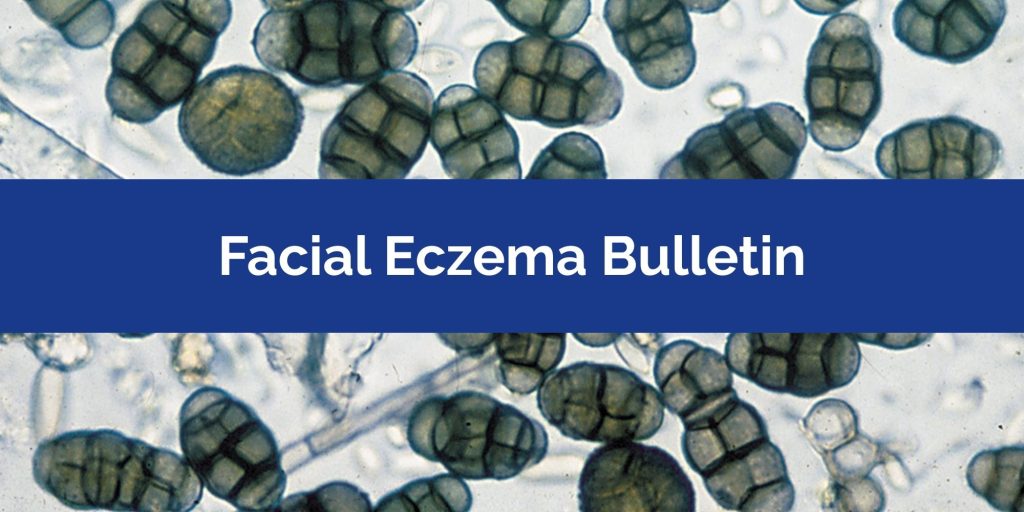
Facial eczema (FE) is what most New Zealand farmers would be familiar with when it comes to photosensitivity diseases. FE occurs in late summer and autumn as a result of ingestion of toxin (sporisdesim) producing spores from pasture that cause liver damage. A damaged liver is unable to remove waste products as effectively, and this buildup of waste is what causes the photosensitivity.
There are several less common and sporadic types of eczema:
- Spring eczema (Sept-Nov)
- Brassica (turnip) photosensitivity
- John’s wort photosensitivity
- Rape scald
There is an iceberg effect that occurs with photosensitivity, as the animals you see with eczema are only a small sample of the affected animals.
With 3% showing eczema whilst up to 50% of the herd can have liver damage but aren’t showing any outward signs.
Studies suggest, unexpectedly, that there is minimal correlation between the severity of eczema and the severity of liver damage.
This hidden mob of liver-damaged animals will often persevere, but will cost you money. The effects in cattle are:
- Decreased weight gains or even weight loss
- Decrease in milk production
- Deaths around calving and lactation
- Reduced reproductive performance
The effects in sheep are:
- Weight loss and decreased weight gains with lambs being affected the most
- Decreased scanning percent in ewes (less multiples, more dry ewes)
- Deaths around lambing
If you suspect your herd may be suffering from liver damage. The best way to gauge the scale of damage is to blood test a sample of animals looking at the quantity of GGT.
GGT is a liver enzyme released into the bloodstream from damaged liver cells. Whilst not a specific indicator for liver damage, it can be a helpful indicator of the herd’s liver damage status.
What can be done for animals affected by eczema?
There is no treatment for eczema and liver damage. We can only support our animals through the disease.
We can do this by sheltering animals showing clinical signs of eczema, providing pain relief and putting dairy cows on once a day milking.
Once you see eczema in your animals it is often too late. The key to eczema is prevention! We can work to prevent eczema by breeding eczema tolerant herds and flocks. However, in the interim, there is a wide range of products for use to prevent liver damage in animals and reduce spores on the pasture. Timing of the treatments is critical, so pasture spore count monitoring is essential to get the best return from the FE management investment.