We have compiled a list of information on facial eczema, frequently asked questions, how we can help you prevent and manage the risk of facial eczema and what your preventative plan should include.
Facial eczema – facts and symptoms
What causes facial eczema?
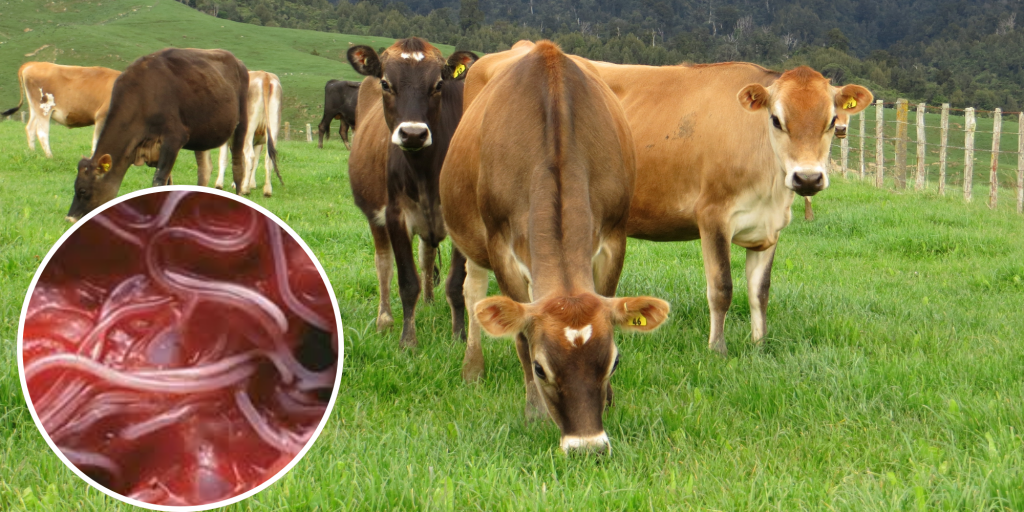
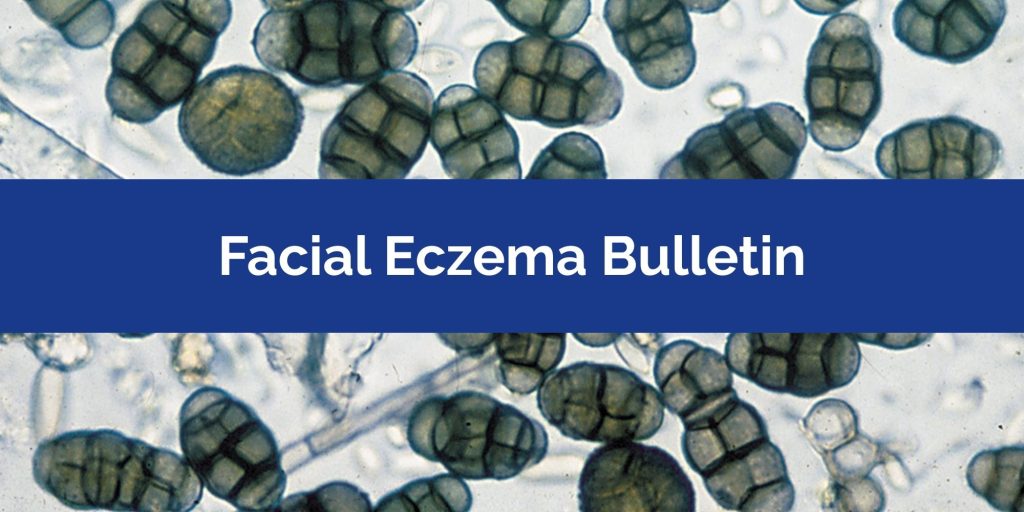
Facial eczema (FE) is caused by the toxin sporidesmin, produced by the spores of the fungus Pithomyces chartarum, which grows rapidly in the base of pastures during warm, humid periods experienced from January to May.
In this part of the country, increased daytime and soil temperatures along with humid airflows that favour fungus growth are usually associated with La Niña weather patterns.

How does the toxin produce disease?
It has destructive effects on bile ducts and liver cells – stock can die from FE as a result of liver failure.
Most affected animals will survive and recover thanks to the liver’s enormous potential for repair and regeneration, but bodyweight and production will be seriously reduced in the short term.
The liver damage can have a long lasting effect – pregnant stock often struggle in the following spring at lambing or calving, due to increased stress on their bodies at that time.
The liver damage caused by the spores tissue impairs this organ’s capacity to detoxify and excrete waste products. One of these waste products is phylloerythrin – a breakdown product of the green pigment in plants, chlorophyll.
It accumulates in various body tissues, including skin, and causes photosensitization, where the animal is sensitive to sunlight.
UV radiation then causes immediate and extremely intense sunburn in poorly or non-pigmented parts of the body.
What to watch for?
Animal species vary in their susceptibility to facial eczema – fallow deer, alpaca and sheep are most susceptible, followed by cattle, red deer and goats.
Signs of FE toxicity also vary between species:
Sheep
Initially, there is increased restlessness, head shaking/rubbing, feet shuffling and shade seeking. This progresses to swollen and drooping ears, eyes and muzzle weeping, jaundice and inappetence.
Cattle
Following ingestion of a toxic dose of FE spores, immediate liver damage causes appetite decline and sharp fall in milk yield.
After 10 to 14 days, there will be signs of photosensitization ie restlessness, kicking off cups, licking flanks and back, flicking tails, seeking shade, purplish discolouration of hairless and non-pigmented skin (especially teats) that progresses to skin crusting and peeling. This can be extensive in white animals.
It is estimated that for every animal with clinical symptoms, there are 10 more with sub-clinical symptoms that go undiagnosed without testing.
Deer
Photosensitivity causes irritability and shade seeking, head shaking, licking lips and muzzle, swollen weepy eyes. Deer deteriorate more rapidly than other stock and a greater proportion will die.
Alpaca
Irritation and restlessness initially, with progression to skin swelling, crusting and oozing (especially around muzzle and ear margins). Death can follow, and because of the stoic nature of these animals, sudden death may be the first sign of disease.
When to start preventative measures?
This decision should be based on:
- FE history of property
- spore count trend over time, locally or on-farm (best)
- prevailing weather conditions
- grazing management
- availability of feed supplements
If you are in any doubt about any aspect of facial eczema, please contact us as soon as possible.
Facial eczema – frequently asked questions
When should I start preventative actions?
Zinc dosing should begin as soon as the weather conditions (warm, humid, grass minimum temps 12°C or higher, heavy dew or 3-4mm rain) favour spore growth and/or at the first signs of spore counts beginning to rise. Don’t wait until dangerous conditions arise, or until clinical cases are seen.
Will four inches of rain wash away the risk?
Not necessarily. If a ‘spore base’ already exists and the nights are warm, expect an explosive increase in spore numbers. Ingestion of spores by stock grazing low enough can result in severe liver damage, immediate production decline, delayed photosensitization (10-14 days later) . However, longer term, the FE risk may have decreased because such rainfall may have kick-started autumn pasture growth.
What is a toxic spore level?
It is best not to use absolute levels, as stock grazing pasture with spore counts as low as 40,000, or several weeks at 20,000, can sustain liver damage. More important considerations are the rate of spore count rise, prevailing weather conditions, and grazing intensity at the time. Toxin effects on the liver are cumulative. Play it safe – start prevention as soon as spores are detected.
How soon after administration are capsules effective? How long do they last?
For Time capsule – within 24hrs. Protective zinc oxide levels are maintained for 4-5 weeks, depending on the stock class dosed.
For Face guard – within 2-3 days. The first treatment lasts 6 weeks, the top up dose 4 weeks.
How safe is it to continue zinc-dosing beyond 100 days?
Often the risk of FE remains high until late into the autumn and outweighs the possible risk of temporary damage to the pancreas – so keep at it! Consider discontinuing treatment for 5-7 days if a sharp cold snap occurs later in the autumn.
What are the withholding periods for stock treated with zinc?
Recent reviews by the New Zealand Food Safety Authority (NZFSA) have removed meat and milk withholding periods on all zinc products.
My herd needs copper – can I continue to supplement with copper while I’m dosing with zinc for facial eczema control?
Options are limited. Inorganic copper forms (eg copper sulphate) compete for absorption, undermining both copper and zinc dosing efforts. Injectable copper preparations have the potential to exaggerate the effects of FE toxin on the liver. Organic copper forms remain effective because their mode of absorption is not antagonised by the presence of zinc compounds. Generally, it is best to consider copper supplementation after the zinc treatment has finished.
How can we help with managing facial eczema?
We provide tailored strategies for managing facial eczema risk. These include:
Pasture spore counting service
We are able to determine spore counts on your property, and follow this up with interpretation of the results and advice.
Sampling Technique: Cut (with shears) a minimum of 60g of pasture (leaf and stalk) to a height of ONE cm above ground level from 8-10 representative sites across paddock. A bread bag should get you enough grass. Sample in grid pattern but avoid sampling in gateways, around water troughs and dung patches, along fence lines.
Paddock Selection: Preferably select paddocks that are the warmest (i.e. north/ north-east facing) and/or sheltered, especially on south/south east boundaries, ryegrass dominant, have a high litter load, (topped, hay aftermath, laxly grazed, summer stalky).
Sample a couple of paddocks if topography (e.g. hills, gullies) or management (e.g. irrigation) varies across the farm.
Trace mineral monitoring
Prolonged zinc compound dosing can interfere with copper metabolism. We recommend a pre-winter mineral status check, including liver biopsy and works liver surveillance. From these results, we provide a report and recommendations with ongoing copper treatment options.
Dose Rate Ready Reckoners
For ease of use, we supply pre-calculated dose rates for zinc requirements.
Sound advice on ‘managing a facial eczema aftermath!’
If you’ve been hit with Facial Eczema previously, your best defence is a good plan for the future.
Your plan should contain steps to:
Predict danger periods and monitor trigger factors associated with the development of toxic spores
- Regularly monitor spore counts for
- your own property (use historical data also)
- District counts and trends
- National and regional spore counts
- Monitor relevant weather conditions
- Grass minimum temperatures
- Rainfall
- Predicted weather patterns
- Monitor pasture growth conditions
- Current pasture cover
- Current and predicted pasture growth rates
- Current pasture quality, in particular, dead matter content
Identify and implement control measures early
There is no ‘cure’ for facial eczema, but there are control measures you can implement. You can
- To decrease the toxic effect of spores by introducing zinc into the diet of your animals
- To reduce the ingestion of spores by grazing stock by inhibiting spore growth
If spore levels are low enough, you can spray your pasture with a fungicide. Spraying your pasture will inhibit spore growth for 4-6 weeks, but it will not kill existing spores. This is why it’s only effective with lower spore counts (less than 20,000sp/gm).
Once your pasture is above 20,000 spores per gram, spraying is no longer an effective option.
You can introduce zinc by bolus, daily drenching, in the water via inline dispensers, header tanks that reticulate the water supply to troughs, or at the feed pad. If you’re unsure of the best method, please just ask.