Potential animal health issues, tasks to consider and reminders for this month include…
February 2026
Dairy – Autumn calving herds
Dry cow therapy (DCT) and/or internal teat sealant (ITS):
If you’re after DCT and/or internal teat sealant ITS you will need to contact your primary veterinarian for a DCT consult as these products are restricted veterinary medicines (RVM’s) that have short authorisation periods not carried over from the last Springs RVM period. This will save any headaches of trying to access product at the front counter of your respective clinics without a current RVM authorisation. The latest SmartSAMM recommendations (Technote 14) is to give every cow something – a DCT product and/or an ITS to treat any infections and to reduce the risk of any new infections over the dry period. Check out ‘Dry cow therapy for the autumn dry off’ for more information.
Rising 2 year old heifers
- Teat sealing – looking to minimise calving mastitis in your heifers? January to February are months we can give you a hand with teat sealing them. Contact your local clinic for organising. Check out ‘Teatseal’ for more information.
- Are your heifers on track to calve at an appropriate weight and body condition? Separate out any small or light heifers. Start feeding nutrient-dense feed on the feed pad or in troughs. Avoid too much bulky feeds like grass silage and avoid high levels of starch (need muscle and skeletal growth not fat gain). An ad lib 80% palm kernel and 20% soyabean mix with grass can provide a good amount of protein, energy and fibre. Can feed them milking cow feeds with minerals if required all the way up to calving.
Trace element supplementation:
Multimin injection 3 – 4 weeks prior to calving (heifers and cows) to help minimise calving mastitis and to reduce subclinical mastitis.
Did you have many down cows, calving mastitis issues, sick calves during autumn calving last season? Your veterinarian can help you make a plan to minimise these issues.
Calf scour vaccinations
Looking to minimise calf scours? Time to vaccinate autumn calving cows with Rotavec Corona vaccine or with Scourguard completing the vaccination protocol 3 – 4 weeks before the planned start of calving. To fully utilise this vaccine make sure all keeper calves are fed enough good quality colostrum within the first 12 – 24 hours from birth.
Dairy – spring calving herds
Once a day (OAD) milking
- This can be a time of year herds may go down to OAD milking (due to: slowing grass growth and feed shortages; summer lifestyle; afternoon heat stress walking to the milking shed and while in the yards during milking; building up body condition; extending lactation out; reducing lameness risk).
- For herds going to OAD think about the bulk milk somatic cell count (BMSCC). BMSCC’s can double in the 1st 48 hours after going to OAD. This can stabilise over 7 – 10 days but there is a risk of grading if the BMSCC is already high prior to OAD milking. If the BMSCC is over 150,000 think about doing a herd test or a rapid mastitis test to identify high somatic cell count (SCC) cows. These cows can be continued to be milked twice a day or they can be removed from the herd – dried off or culled before the transition.
- Before going to OAD manage risk factors – stress and poor immune function. Make sure mineral levels are optimum (Ca, P, Se), aim to OAD before the cows are producing less than 1 kg milk solids/cow/day, milk in the morning to minimise afternoon heat stress, initially keep close to the shed to minimise walking distances, make sure there is good water access for all cows and keep feeding the cows enough of a well-balanced diet. Don’t forget about facial eczema. Rising spore counts can lead to stress, inflammation and a rising BMSCC.
BMSCC:
For herds with a rising BMSCC check out ‘Preventing BMSCC grading in late lactation’ for more information.
Pregnancy testing:
Pregnancy testing the milking cows and some of the heifers will be underway. If your heifer pregnancy testing hasn’t been booked in yet, talk to your primary veterinarian. We can travel out of district to pregnancy test heifers out grazing.
Heifers out grazing:
Don’t forget about these girls. Are they getting fed enough, are you happy with their growth rates? Summer can be a period of poor growth in our heifers – is there a plan to get extra feed to them or to move them elsewhere if the grazing is below requirements?
Dairy – Spring born calves
Clostridial and leptospiral vaccinations:
Have all your weaner calves had their booster clostridial and leptospiral vaccinations yet? Check out ‘Calf vaccination and mineral treatments’ for more information.
Parasites:
- Keep up the oral drenching with a combination drench product like Alleva’s Turbo Advance for as long as possible. Can check 10 faecal samples for parasite eggs 1 month after the last drench to determine the requirement for a follow up drench. It also pays to periodically check 10 faecal samples 10 days after a drench event to check how well the drench is working.
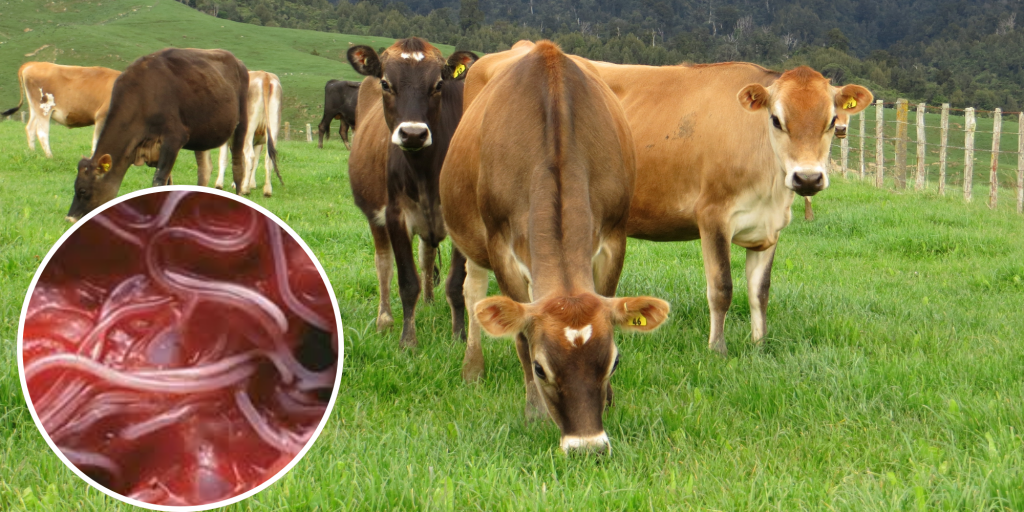
- Lungworm is killing weaners at the moment and can do so within 28 days of the last drench. Don’t ignore coughing calves. If in doubt, get us some faecal samples to check for lungworm. Check out ‘Lungworm‘ for more information.
Keep an eye out for ill-thrifty, scouring calves or calves struggling to breathe and an ear out for coughing calves:
Don’t leave them be. It pays to investigate – a vet visit or bringing in some faecal samples to check for parasitism or Yersinia for example. Lost production now through a dry spell can take a long time to recover from, if at all, and can lead to poorly grown heifers at calving, which is common.
Dairy – Facial Eczema
We are starting to get conditions favourable to FE spore development – dead pasture matter, rain and warmth.
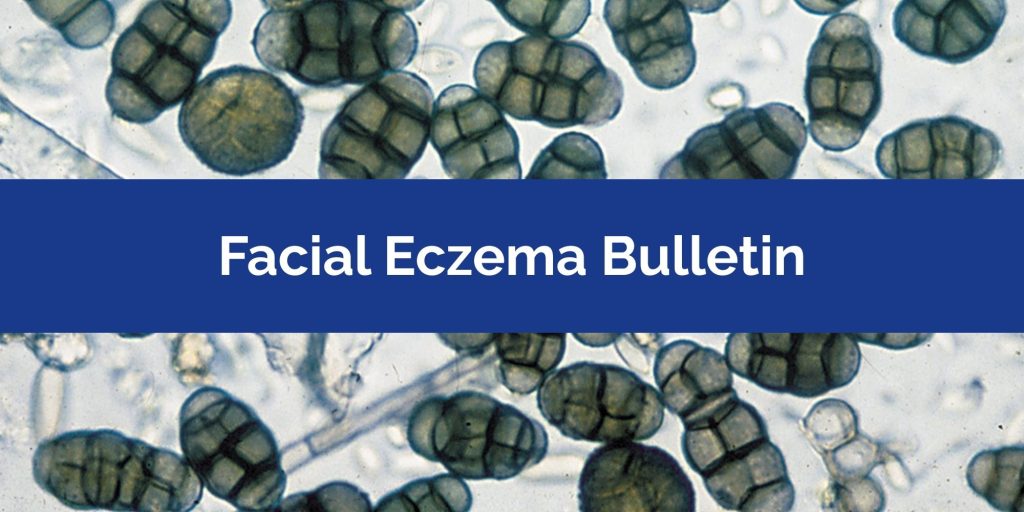
Start testing your pasture for FE spores or keep a close eye on your regional spore counts as posted on the Totally Vets website. Check out our Facial Eczema Bulletin, Facial eczema – all you need to know and Facial eczema risk for more information.
There is no ‘cure’ for FE – only supportive treatments. Start your preventative zinc supplementation program prior to animals consuming spores or as soon as regional spore counts start rising. If zinc sulphate is supplemented through the water start with a loading ½ strength dose and build up to a full dose over a few weeks. Add a flavourant. Zinc can be also offered daily in the feed or as a capsule down the throat.
Check blood samples 2 – 3 weeks later to check if animals are getting supplemented with enough zinc.
Sheep, Beef, Deer
Lambs
Worms and pneumonia:
- If January and February are hot summer months – watch out for mustering and pushing lambs too hard, yarding too tightly or for too long a period in hot dusty conditions. Equals increased pneumonia risk. Any situation that increases open mouth breathing in the lambs will increase pneumonia risk. Same applies to transporting lambs.
- Pneumonia plus worms can smash immune function and increase risk of death. Last year, when sheep farmers were dealing with black scour worm issues from March onwards, we had periods where lambs were dying from a combination of worms and pneumonia. Controlling both as much as possible will decrease the risk of deaths.
- Start checking 10 faecal samples 10 days after a drench event to check how effective the drench has been and check 10 faecal samples 28 days after a drench event to check the requirement for a drench. Regular faecal egg counts (FEC’s) can help with making the right drench choice, with checking how well the drench is working (a poorly effective drench will lead to poor productivity and growth in your lambs), with estimating climbing parasite challenge, and for working out if sheep require a drench event.
- If you are drenching for barbers pole check out the meat withhold before you drench. It’s frustrating if you accidentally dose a lamb not far off slaughter with a 56 day meat withhold drench product.
B12/selenium:
- Some lambs will be getting slaughtered. If you would like some liver B12 and selenium levels checked contact us. We can fill out a Mineral Check form on the phone (we just need some details), with copies passed to the trucking company and the works premises. Results will get emailed back to us for comment.
- Low B12 and/or selenium – supplement with Smartshot B12 +/- selenium.
Clostridial vaccine:
Some lambs will be getting a booster dose of a clostridial vaccine. For best effect make sure the vaccination course is completed before lambs go onto high energy feeds. Watch out when using a vaccine product containing selenium. Some selenised vaccines are not suitable for smaller lambs and can cause death if accidentally administered.
Dying lambs:
Don’t ignore. We can post-mortem some if they are dying (and we can get to the dead animal quick enough). The 4 main diseases that can kill lambs over the summer – worms, pneumonia, facial eczema and clostridial disease can generally be diagnosed quickly. They are diseases that can be minimised. We can teach you how to do a quick post-mortem to check lungs, liver, and gut.
Ewes
Pre-mating preparation:
Toxovax & Campyvax vaccinations occurring and even Salvexin B vaccinations for Salmonellosis prevention, plus more farmers are supplementing ewes 4 weeks before mating with mineral products like Multimin Copper Free injection to improve fertility. Check out Improving sheep performance through vaccination and Salmonella in sheep for more information on vaccines and these diseases and check out Sheep Flock Productivity for more information on Multimin Copper Free injection.
Rams
Pre-mating preparation:
Don’t forget your rams. Check their teeth, body condition structural soundness and make sure they’ve been vaccinated to prevent clostridial disease as well. Book in your ram palpations and any vasectomy surgeries to prep rams for teasering. Check out Palpating the ram for more information
All Sheep
Fly, barbers pole and facial eczema:
All can be a problem this month. We already have a suspected case of barbers pole – lethargic ewe, pale, egg count > 3000. Watch for and prevent fly. With sporadic rain and warm weather fly, barbers pole and facial eczema risk all climb. Check out Barber’s Pole Worm for more information.
Deer
Look out for coughing fawns/weaners
It could be lungworm. Check out Lungworm in cattle and deer for more information.
Pre-rut weaning:
- Starting to occur. Weaning is both stressful for hinds and fawns. Ideally spread stressful events out so not all occurring on the same day i.e. tagging and clostridial vaccination prior to weaning (gets fawns used to the yards as well prior to weaning), booster clostridial vaccination and Yersiniavax at weaning (some weaners will be transported the same day as well) and Multimin and Yersiniavax booster injections 3 – 4 weeks later. Ideally no copper injection and transportation on the same day. Use quiet dogs and muster and yard during the cool parts of the day if hot and avoid weaning in bad weather.
- It is a legal requirement that fawns being transported to another property must be transported within 6 hours of weaning or wait until at least 10 days post-weaning (preferable).
- Put as much space as possible between the hinds and weaners post- weaning.
- Try and introduce any post-weaning feed to fawns before they are weaned (i.e. grain and baleage) for better transitioning onto those feeds after weaning.
- Hinds – a good time to body condition hinds and to check teeth. Keeper hinds can be administered minerals (i.e. Multimin). Light hinds can be drafted, drenched and preferentially feed.
- Treatment & prevention products – fawns/weaners – Yersiniavax (fawns should be > 12 weeks old) + Clostridial & Leptospiral vaccine (i.e. Ultravac 7 in 1), plus drench (Cervidae Oral) plus minerals (Copacap bolus or Multimin injection)
Sheep, Beef, Deer – Facial Eczema
We are starting to get conditions favourable to FE spore development – dead pasture matter, rain and warmth.
Start testing your pasture for FE spores or keep a close eye on your regional spore counts as posted on the Totally Vets website. Check out our Facial Eczema Bulletin, Facial eczema – all you need to know and Facial eczema risk for more information.
There is no ‘cure’ for FE – only supportive treatments. Start your preventative zinc supplementation program prior to animals consuming spores or as soon as regional spore counts start rising. If zinc sulphate is supplemented through the water start with a loading ½ strength dose and build up to a full dose over a few weeks. Add a flavourant. Zinc can be also offered daily in the feed or as a capsule down the throat.
Check blood samples 2 – 3 weeks later to check if animals are getting supplemented with enough zinc.
January 2026
Facial eczema:
From 12th January we will start monitoring spore counts from grass samples taken from a number of monitor farms scattered throughout the Manawatu, Tararua, Horowhenua and Taumaranui regions. Check out our Facial Eczema Bulletin, Facial eczema – all you need to know and Facial eczema risk for more information.
Dairy
Autumn calving herds:
- Setting late lactation cows up for drying off – minimising metabolics and mastitis risk:
- Trim tails, check mineral levels, keep supplementing calcium and selenium, and keep teat spraying. Calcium (Ca), phosphorus (P), magnesium (Mg) and selenium (Se) are required for immune function, teat canal closure and cow health. We can check mineral levels by testing 10 blood samples. It is best and easiest to correct deficiencies during lactation and when cows aren’t under any pressure. Cows should still be getting supplemented with calcium. Too many cows have low Se, Ca and P levels in late lactation. Mg could be too high or too low.
- Dry cow therapy (DCT) and/or internal teat sealant (ITS):
- If you’re after DCT and/or internal teat sealant ITS you will need to contact your primary veterinarian for a DCT consult as these products are restricted veterinary medicines (RVM’s) that have short authorisation periods not carried over from the last Springs RVM period. This will save any headaches of trying to access product at the front counter of your respective clinics without a current RVM authorisation.
- The latest SmartSAMM recommendations (Technote 14) is to give every cow something – a DCT product and/or an ITS to treat any infections and to reduce the risk of any new infections over the dry period. Check out Dry cow therapy for the autumn dry off for more information.
- Teat sealing heifers:
- Looking to minimise calving mastitis in your heifers? January to February are months we can give you a hand with teatsealing them. Contact your local clinic for organising.
Spring calving herds:
- Late mating cows and bulls:
- Some cows will still be getting mated. Some bulls will be sold. Any lame bull going to the works will require a veterinarian certificate and under this certificate they will have to go to the closest works.
- Once a day (OAD) milking:
- This can be a time of year herds may go down to OAD milking (due to: slowing grass growth and feed shortages; summer lifestyle; afternoon heat stress walking to the milking shed and while in the yards during milking; building up body condition; extending lactation out; reducing lameness risk).
- For herds going to OAD think about the bulk milk somatic cell count (BMSCC). BMSCC’s can double in the 1st 48 hours after going to OAD. This can stabilise over 7 – 10 days but there is a risk of grading if the BMSCC is already high prior to OAD. If the BMSCC is over 150,000 think about doing a herd test or a rapid mastitis test to identify high somatic cell count (SCC) cows. These cows can be continued to be milked twice a day or they can be removed from the herd – dried off or culled before the transition.
- Before going to OAD manage risk factors – stress and poor immune function. Make sure mineral levels are optimum (Ca, P, Se), aim to OAD before the cows are producing less than 1 kg milk solids/cow/day, milk in the morning to minimise afternoon heat stress, initially keep close to the shed to minimise walking distances, make sure there is good water access for all cows and keep feeding the cows enough of a well-balanced diet. Don’t forget about facial eczema. Rising spore counts can lead to stress, inflammation and a rising BMSCC.
- BMSCC:
- For herds with a rising BMSCC check out Preventing BMSCC grading in late lactation for more information.
- Pregnancy testing:
- Has your milking cow pregnancy testing been booked in.
Spring born calves:
- Minimising post-weaning disease:
- For the later born beef calves we recommend a Multimin injection (to minimise post-weaning disease), a clostridial +/- leptospiral vaccination and a weaning drench. We recommend the oral combination Alleva drench products Turbo Initial (if coccidia a problem) or Turbo Advance as these can now be used in calves as low as 50kg.
- For earlier born replacement heifers make sure your clostridial and leptospiral vaccination booster dose is within 6 weeks of the sensitiser vaccination injection. If these calves haven’t had their Multimin injection – now’s the time. Can check 10 faecal samples for parasite eggs 1 month after the last drench to determine the requirement for a follow up drench. Recommend using the oral Alleva Turbo Advance drench until calves are too big to manage.
- Keep an eye out for ill-thrifty, scouring calves or calves struggling to breathe and an ear out for coughing calves:
- Don’t leave them be. It pays to investigate – a vet visit or bringing in some faecal samples to check for parasitism or Yersinia for example. Lost production now going into a dry spell can take a long time to recover from, if at all, and can lead to poorly grown heifers at calving, which is common.
Sheep, beef and deer
Lambs:
- Weaning is still happening for some, and shearing for others.
- Worms and pneumonia:
- If January and February are hot summer months – watch out for mustering and pushing lambs too hard, yarding too tightly or for too long a period in hot dusty conditions. Equals ↑ pneumonia risk. Any situation that ↑ open mouth breathing in the lambs will ↑ pneumonia risk. The same applies to transporting lambs.
- Pneumonia plus worms can smash immune function and ↑ risk of death. Last year, when sheep farmers were dealing with Black Scour Worm issues from March onwards, we had periods where lambs were dying from a combination of worms and pneumonia. Controlling both as much as possible will ↓ the risk of deaths.
- Lambs might be going back onto pasture they were born on, which can increase parasite consumption risk – they may need a knock out drench with Zolvix or Startect earlier than those that don’t wean their lambs back onto lambing country.
- Start checking 10 faecal samples 10 days after a drench event to check how effective the drench has been and check 10 faecal samples 28 days after a drench event to check the requirement for a drench. Regular faecal egg counts (FEC’s) can help with: making the right drench choice; for checking how well the drench is working (a poorly effective drench will lead to poor productivity and growth in your lambs); for estimating climbing parasite challenge; and for working out if sheep require a drench event.
- If you are drenching for barbers pole check out the meat withhold before you drench. It’s frustrating if you accidentally dose a lamb not far off slaughter with a 56 day meat withhold drench product.
- B12/selenium:
- Some lambs will be getting slaughtered. If you would like some liver B12 and selenium levels checked contact us. We can fill out a Mineral Check form on the phone (we just need some details), with copies passed to the trucking company and the works premises. Results will get emailed back to us for comment.
- Low B12 and/or selenium – supplement with Smartshot B12 +/- selenium.
- Clostridial vaccine:
- Some lambs will be getting a sensitiser or booster dose of a clostridial vaccine. For best effect make sure the vaccination course is completed before lambs go onto high energy feeds. Watch out when using a vaccine product containing selenium. Some selenised vaccines are not suitable for smaller lambs and can cause death if accidentally administered.
- Dying lambs:
- Don’t ignore! We can post-mortem some if they are dying (and we can get to the dead animal quick enough). The 4 main diseases that can kill lambs over the summer – worms, pneumonia, facial eczema and clostridial disease can generally be diagnosed quickly. They are diseases that can be minimised. We can teach you how to do a quick post-mortem to check lungs, liver, and gut.
Ewes:
- Post-weaning checks:
- Time for uddering, mouthing and condition scoring ewes. Light ewes can be preferentially managed (extra feed, drench etc.) and reject ewes culled.
- Pre-mating preparation:
- Toxovax & Campyvax vaccinations occurring and even Salvexin B vaccinations for Salmonellosis prevention, plus more farmers are supplementing ewes 4 weeks before mating with mineral products like Multimin Copper Free injection to improve fertility. Check out Improving sheep performance through vaccination and Salmonella in sheep for more information on vaccines and these diseases and check out Sheep Flock Productivity for more information on Multimin Copper Free injection.
Rams:
- Pre-mating preparation:
- Don’t forget your rams. Check their teeth, body condition structural soundness and make sure they’ve been vaccinated to prevent clostridial disease as well. Book in your ram palpations and any vasectomy surgeries to prep rams for teasering. Check out Palpating the ram for more information.
All sheep:
- Fly, barbers pole and facial eczema:
- All can be a problem this month. We already have a suspected case of barbers pole – lethargic ewe, pale, egg count > 3000. Watch for and prevent fly. With sporadic rain and warm weather fly, barbers pole and facial eczema risk all climb. Check out Barber’s Pole Worm for more information.
Deer:
- Some hinds will still be fawning.
- Look out for coughing fawns/weaners – could be lungworm. Check out Lungworm in cattle and deer for more information.
- Check for ticks on stags coming in for velvet regrowth harvesting.